
Custom Fabric Print File Requirements: A Guide
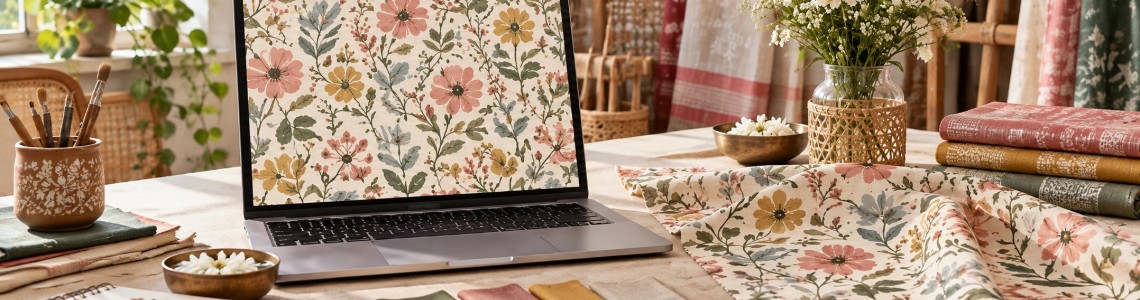
A design that looks perfect on screen can print blurry, misaligned, or completely different in color if the file isn't prepared correctly for textile printing. Here's exactly what to check before submitting artwork for a custom fabric print, so the first proof comes back close to what you actually intended.
On This Page
File Type: Vector vs. Raster
Vector files (AI, EPS, or vector PDF) are built from mathematical paths rather than pixels, so they scale to any size without losing quality — ideal for clean geometric patterns, logos, or line-based designs. Raster files (high-resolution PNG, TIFF, or PSD) are pixel-based and better suited to painterly, photographic, or watercolor-style designs, but only if the resolution is high enough to begin with, since a raster file can't be scaled up cleanly the way a vector file can.
"A file that looks sharp on your screen at 100% isn't the same as a file that prints sharp at fabric scale."
Resolution and DPI
For raster artwork, 300 DPI at the actual intended print size is the standard benchmark for sharp detail on fabric — a file that looks fine on a screen at low resolution can print visibly blurry or pixelated once scaled to garment size. If you're working from a smaller source image, check its resolution at full size before submitting rather than assuming it will scale cleanly.
Understanding Repeat Patterns
Most fabric prints aren't one large image — they're a smaller motif repeated continuously across the roll, and how that repeat is structured affects both cost and visual result.
- Straight (block) repeat: the motif repeats in a simple grid — straightforward to produce and align
- Half-drop repeat: alternating rows shift by half the motif's height, creating a less obviously gridded look
- Seamless (continuous) repeat: the motif is designed so its edges match up invisibly when tiled, avoiding visible seams across the fabric
If you're not experienced with repeat design, working from Trativaa's print design collection as a visual reference for what prints well as a continuous repeat can help before finalizing your own artwork through the custom print service.
Color Mode and Matching
Design software typically works in RGB, the color mode for screens, while textile printing works in CMYK or a dedicated textile ink profile — colors can shift noticeably in this conversion, particularly bright or highly saturated tones. If exact color matching matters for a brand palette, providing Pantone reference numbers alongside the file gives the printer a fixed target rather than relying on how a color displays on any one screen, which varies by monitor.
The Strike-Off Proofing Process
A strike-off is a small printed sample of your design on the actual fabric base before full production — this is the point to catch color shifts, scale issues, or repeat misalignment while it's still cheap to fix. Always request and approve a strike-off before bulk production on any new design, even if you've worked with the same supplier before, since fabric batches and ink can vary slightly between print runs.
Submit Your Design for a Proof
Send your artwork and get a strike-off sample before committing to bulk printing.
Start Custom DesignFrequently Asked Questions
What resolution do I need for a custom fabric print?
300 DPI at your intended print size is the standard benchmark for sharp detail — check this at full scale, not just how the file looks zoomed out on screen.
Why do my colors look different once printed on fabric?
Screens display in RGB while textile printing uses CMYK or a dedicated ink profile, and the conversion between the two can shift color noticeably — providing Pantone references helps minimize this.
Is a strike-off proof necessary if I've ordered from the same supplier before?
It's still worth requesting for any new design, since fabric batches and ink can vary slightly between production runs even with a familiar supplier.
Getting these technical details right before submission saves rounds of back-and-forth and gets a design from first file to approved strike-off far faster — worth the extra care upfront, especially on a design you're planning to reorder repeatedly.
Custom Fabric Print File Requirements Fabric Design Repeat Pattern Textile Artwork Submission DPI For Fabric Printing Strike-Off Proof
Leave a Comment